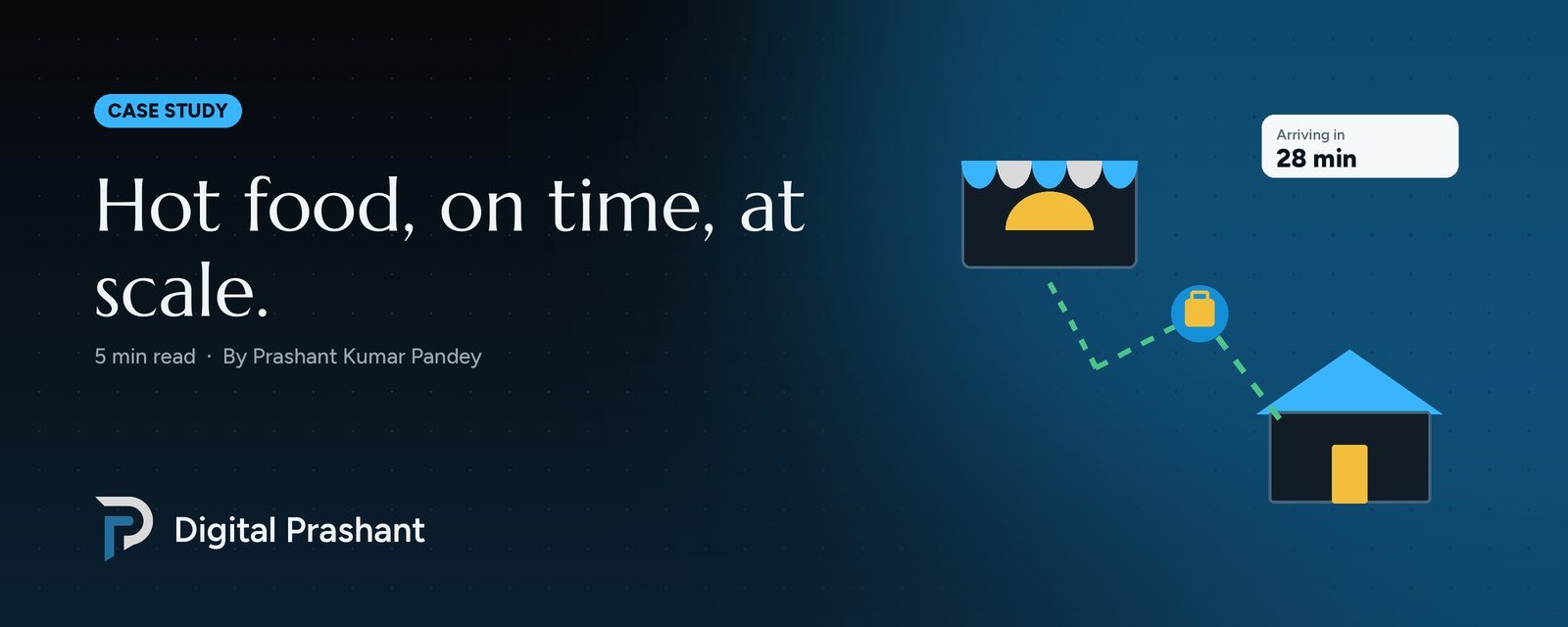
Swiggy Case Study: How Your Food Reaches You So Fast
By Prashant Kumar Pandey, Founder, Digital Prashant Published 05 Nov 2026 · 6 min read
Quick answer
Swiggy splits every order into stages (restaurant prep, rider assignment, travel to the restaurant, pickup and last mile) and predicts each with machine-learning models. It assigns the rider who can reach the restaurant just as the food is ready, batches orders going the same way, and for 10-minute Bolt it only uses nearby restaurants and quick-to-prepare dishes.
You order a biryani, and about half an hour later a delivery partner is at your door with it still hot. In some areas Swiggy even promises food in 10 minutes. Making that happen thousands of times a minute is not just about fast bikes. It is a prediction problem, a matching problem and a timing problem, solved with data. This case study explains how Swiggy's app works, how a rider gets your order, and the technology behind fast delivery.
Swiggy at a glance
Food delivery, Instamart (quick commerce) and Dineout in one app.
About 5.15 lakh average monthly transacting delivery partners in FY25.
About 2.38 lakh average monthly transacting restaurant partners in FY25 (up from 1.29 lakh in FY22).
1,021 Instamart dark stores at the end of FY25, with an average delivery time of about 13 minutes.
The journey of one order
To promise an arrival time, the app splits every order into stages and predicts each one:
Stage
What happens
What the system must predict
1. Order placed
You pay; the restaurant gets the order
Will the restaurant accept quickly?
2. Food preparation
The kitchen cooks and packs
How long this dish takes at this restaurant, at this hour
3. Rider assignment
A delivery partner is chosen
Which free rider can reach the restaurant just as food is ready
4. First mile
Rider travels to the restaurant
Travel time in current traffic
5. Pickup
Rider collects the parcel
Waiting time at the counter
6. Last mile
Rider travels to you
Travel time, plus time to find your gate and floor
The ETA you see is roughly the sum of these stages. Machine-learning models predict each one from past orders, time of day, weather and live conditions, and the ETA keeps updating as the order moves.
How a rider gets your order
The key idea is timing. If a rider reaches the restaurant too early, he waits and the system loses his time. If he reaches too late, your food goes cold. Public talks and engineering write-ups about Swiggy describe an assignment system that looks at:
Where every free rider is right now.
How long each one would take to reach the restaurant.
When the food is expected to be ready.
Where the rider's current delivery ends, so a rider finishing nearby can be lined up for the next order.
Assignment is a continuous calculation, re-run as new orders come in and riders become free. A Swiggy data scientist's talk at The Fifth Elephant 2018 listed the building blocks: demand forecasting, real-time pairing of orders and riders, delivery-stage predictions, order batching and controls for the supply side.
Batching: two orders, one trip
When two orders come from the same restaurant or area and go in the same direction, one rider can carry both. Batching saves rider time and lowers cost, but it can add a few minutes for one of the customers, so it has to be used carefully. Swiggy offers an opt-in Eco Saver option where customers agree to batched delivery.
10-minute food: how Bolt works
Swiggy launched Bolt in October 2024. The speed comes from design choices, not from riders driving faster:
Only restaurants within 2 km of the customer are included.
Only dishes that need little or no preparation time, such as burgers, beverages, breakfast items, ice cream and sweets.
Restaurants with fast order turnaround are chosen.
Swiggy said delivery partners are not told which orders are Bolt orders, so there is no penalty or reward linked to delivery time.
Swiggy reported that Bolt contributed over 12% of food delivery orders within six months of launch.
Instamart and the dark-store model
Grocery in 10–15 minutes works because the products are already close to you, in small warehouses called dark stores. Swiggy had 1,021 of them at the end of FY25. Swiggy's VP of Data Science, Goda Ramkumar, told Business Today that deep-learning models predict delivery times and that the system even picks the right vehicle: bicycles for close deliveries and motorbikes for longer ones. Demand forecasting decides what each store stocks.
Rain, cricket matches and New Year's Eve
Peaks are the hardest part. When it rains or a big match is on, orders jump and riders slow down at the same time. A 2018 Swiggy talk named IPL weekends, rain and New Year's Eve as examples, and described combining time-series forecasting, operations research, machine learning and simulation to keep delivery promises. In practice you see this as longer ETAs, surge or rain fees, or some restaurants showing as unavailable for a while: the app limits how much it accepts so it can still deliver what it promised.
The technology stack, in simple words
Job
Technology idea
Predict delivery time
Machine-learning and deep-learning models trained on past orders
Assign riders
Real-time matching that balances rider distance and food-ready time
Combine orders
Batching logic for orders going the same way
Plan for peaks
Demand forecasting, simulation and capacity controls
Live tracking
Rider app sends GPS location; your app shows it on a map
Show you the right food
Personalised recommendations from your order history
Help restaurants sell
In-app advertising and analytics for partners
What business owners can learn from Swiggy
Promise a time, then keep it. Swiggy shows an ETA before you order. Tell your customers exactly when they will get a callback, a quote or a delivery, and track whether you keep it.
Break the process into stages. Swiggy measures prep, pickup and travel separately. Measure your funnel the same way: ad click, enquiry, first reply, visit, sale. The slowest stage is where to fix first.
Plan for your rush hours. Festivals, salary days and weekends are your "rain days". Plan ad budgets, staff and stock in advance.
Recommend, don't just list. Personalised suggestions raise order value. A simple version for you is WhatsApp follow-ups based on what a customer bought last time. See our guide on WhatsApp marketing.
Hyperlocal works. Bolt only serves 2 km. Your ads can do the same: target the area where you can actually serve customers well.
It predicts each stage of the order (food preparation, rider travel to the restaurant, pickup wait and the last mile to you) using machine-learning models trained on past orders, then updates the ETA live as the order moves.
How does a Swiggy rider get an order?
The system looks at where free riders are, how long each would take to reach the restaurant and when the food will be ready, and assigns the order so the rider arrives close to the time the food is packed.
How is Swiggy Bolt so fast?
Bolt only covers restaurants within 2 km and dishes that need little or no preparation. Swiggy says riders are not told which orders are Bolt orders, so they are not pushed to ride faster.
What is a dark store?
A small warehouse that is not open to walk-in customers and only packs online orders. Swiggy Instamart had 1,021 dark stores at the end of FY25, which is how groceries can arrive in about 13 minutes.
Prashant Kumar Pandey
Founder of Digital Prashant and a performance marketer since 2018. He has generated 10,000+ leads with Meta Ads and managed ad budgets up to ₹40 lakh a month. View profile.