Ola Case Study: How the App Finds You a Cab in Seconds
By Prashant Kumar Pandey, Founder, Digital Prashant Published 05 Nov 2026 · 6 min read
Quick answer
When you tap Book, Ola finds online drivers near your pickup point, ranks them by real road ETA (not straight-line distance), prices the ride for current demand and offers it to the best driver. Its own Ola Maps platform (built on OpenStreetMap, OSRM routing and live vehicle GPS data) powers pickup points, routes and ETAs.
You open the app, tap Book, and within seconds a driver is on the way with a live ETA on your screen. It looks simple. Behind that tap sit maps, live traffic models, pricing rules and two separate apps (one for riders, one for drivers) talking to each other in real time. This case study breaks down how Ola's app works, what technology it runs on, and what any business owner can learn from it.
Ola at a glance
Founded by Bhavish Aggarwal and Ankit Bhati; Ola Cabs launched in January 2011.
Rides on cabs, autos and bike taxis across 250+ Indian cities.
Ola Cabs was renamed Ola Consumer in August 2024.
In 2024 Ola moved to its own map platform (Ola Maps) and its own cloud (Krutrim).
What happens in the seconds after you tap "Book"
Every ride-hailing app has to solve the same puzzle: put the right driver in front of the right rider as fast as possible, at a price both accept. In simple steps, the flow looks like this:
Pickup point. Your phone's GPS gives a location; the map "snaps" it to the nearest road so the driver gets a pickup point he can actually reach.
Nearby supply. The system looks at drivers who are online, free and close to you. Their apps keep sending location pings every few seconds.
Real ETA, not straight-line distance. A driver 800 m away across a flyover can be slower than one 1.5 km away on the same road. Routing on the live road network decides who is truly "nearest".
Fare. The price is calculated from distance, time, vehicle type and demand at that moment (see surge pricing below).
Offer and accept. The ride is offered to a driver. If he declines or does not respond, it moves to the next best driver.
Navigation and live tracking. Turn-by-turn directions for the driver; a moving car icon and updated ETA for you.
Payment and rating. Cash, UPI or wallet, then ratings on both sides, which feed back into future matching quality.
Ola has not published every detail of its matching logic, so the steps above describe how ride-hailing dispatch generally works. The parts Ola has made public are about its maps, and they are the most interesting part of the story.
The technology behind the app
Layer
What it does
What Ola uses (public information)
Map data
Roads, places, turns, signals
OpenStreetMap as a base, improved with Ola's own edits, vehicle GPS data and street imagery
Routing & ETA
Best route and arrival time
OSRM (open-source routing engine) with a custom algorithm, plus live speed models
Search
"Where to?" autocomplete
Pelias-based autocomplete with language and ranking models
Map display
The map you see on screen
MapLibre-based tile rendering
Live traffic
Which roads are slow or closed
Models trained on anonymised vehicle pings, plus road-closure signals
Cloud
Servers that run everything
Krutrim, Ola's own cloud (moved off Microsoft Azure in 2024)
Why Ola built its own maps
Maps are the heart of a cab app: pickup points, routes, ETAs and fares all depend on them. In July 2024 Bhavish Aggarwal announced that Ola had completely moved away from Google Maps, and said the company had been spending about ₹100 crore a year on it. That cost, he said, had come down to zero.
In its technical write-up, Ola described how the maps are built:
OpenStreetMap for the base layer, with 5.43 million edits made by Ola's team in a year.
Anonymised GPS pings from 2-, 3- and 4-wheelers to find missing roads, congestion and restrictions.
360° cameras on Ola S1 scooters to read shop names, traffic signs and turns.
A data pipeline that takes in over 5 million messages per second.
Ola reported that its new routing engine reduced cancellations by 9%, improved pickup accuracy by 6% and reduced pricing deviations by 2%. These are the company's own figures and have not been independently verified, but they show why maps matter: a wrong pickup pin means a call, a delay or a cancelled ride.
Surge pricing: how fares go up (and the limits)
When demand is higher than the number of free drivers (office hours, rain, festivals), fares rise. The higher fare does two jobs: it pulls more drivers online and nudges some riders to wait. In India this is now regulated. Under the Motor Vehicle Aggregator Guidelines 2025, announced in July 2025:
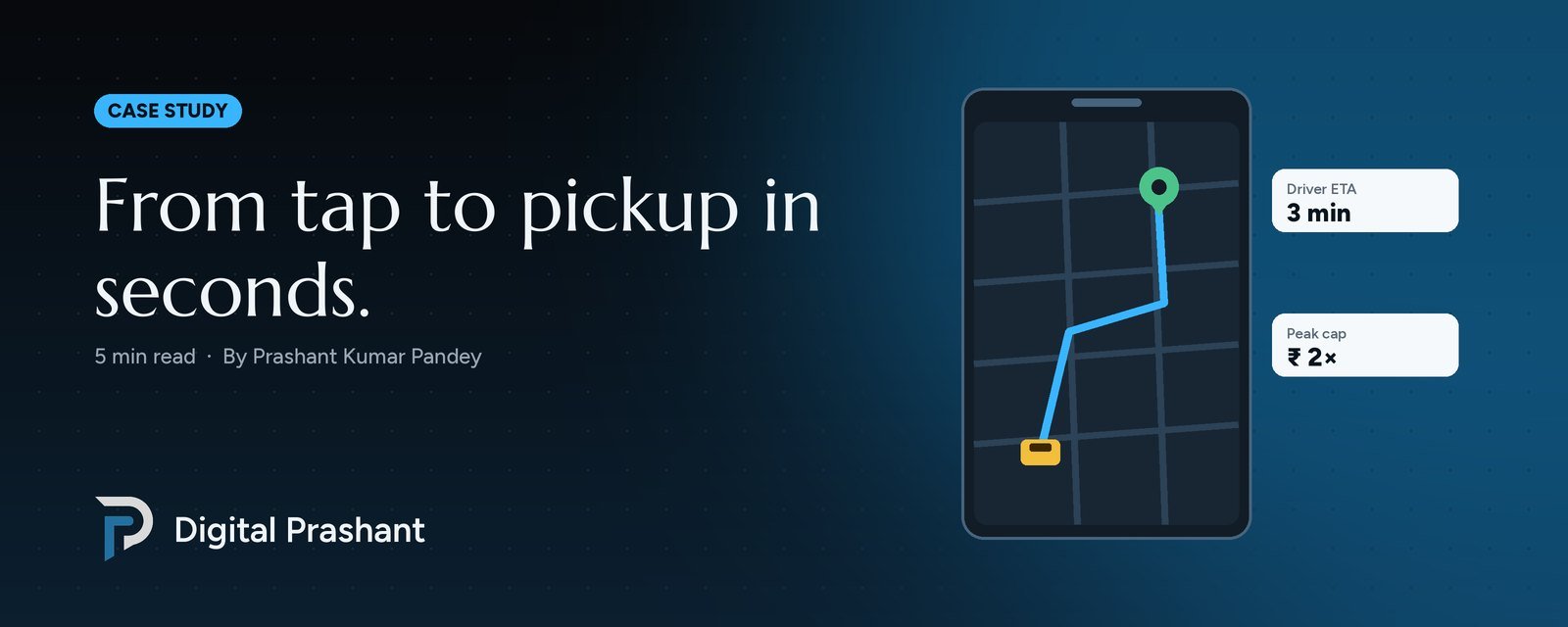
Aggregators can charge up to 2× the base fare at peak times (earlier the cap was 1.5×).
In non-peak hours the fare must be at least 50% of the base fare.
Drivers must get at least 80% of the fare.
Cancelling without a valid reason after accepting a ride costs 10% of the fare, up to ₹100.
States were given three months to adopt the guidelines, so exact rules can differ by state.
The driver side: zero commission
A cab app only works if enough drivers stay online. In June 2025 Ola rolled out a zero-commission model across India for autos, bikes and cabs: instead of giving a cut of every ride, drivers buy a plan and keep the full fare. Reports put the cab plan at ₹67 a day or ₹2,010 for 30 days. Ola said more than one million driver partners were on the platform. For the app, this is a supply decision: more drivers online means shorter pickup times, which means happier riders.
What business owners can learn from Ola
Speed wins the customer. Ola's whole system exists to cut waiting time. The same is true for your enquiries: a lead called back in 5 minutes behaves very differently from one called after 5 hours. Set up instant WhatsApp replies and a clear follow-up process.
Own your important data. Ola built its own maps because maps were core to its business. For you, the core asset is your customer list, reviews and ad data. Keep ad accounts and lead data in your own name.
Location is everything. Ola's pickup accuracy came from better location data. For a local business, an accurate Google Business Profile and location-targeted ads do the same job.
Be transparent about price. Surge pricing is accepted (mostly) because riders see the fare before they book. Clear pricing on your website reduces drop-offs.
Measure the leak. Ola tracks cancellations closely. Track where your leads drop off: ad click, form, call, visit or payment.
No. In July 2024 Bhavish Aggarwal said Ola had completely moved to its in-house Ola Maps, saving about ₹100 crore a year that it used to spend on Google Maps.
How does Ola decide which driver gets my ride?
Ola has not published its full matching logic. Ride-hailing apps generally offer the ride to an available driver with the best real road ETA to your pickup point, and move to the next driver if one declines.
How much can Ola charge during peak hours?
Under India's Motor Vehicle Aggregator Guidelines 2025, cab aggregators can charge up to 2 times the base fare in peak hours, and at least 50% of the base fare in non-peak hours. States adopt the rules, so details can vary.
What is Ola's zero-commission model?
Since June 2025 Ola drivers pay a fixed plan (reported at ₹67 a day or ₹2,010 for 30 days for cabs) instead of a commission on each ride, and keep the full fare.
Prashant Kumar Pandey
Founder of Digital Prashant and a performance marketer since 2018. He has generated 10,000+ leads with Meta Ads and managed ad budgets up to ₹40 lakh a month. View profile.